Plant data stays on your plant network.
Eolvision runs on-premises within your plant network perimeter. Inspection images never leave your facility unless you configure cloud sync.
On-premises by default. Cloud optional.
The inspection pipeline runs entirely inside your plant network boundary. No cloud connection is required for real-time inspection.
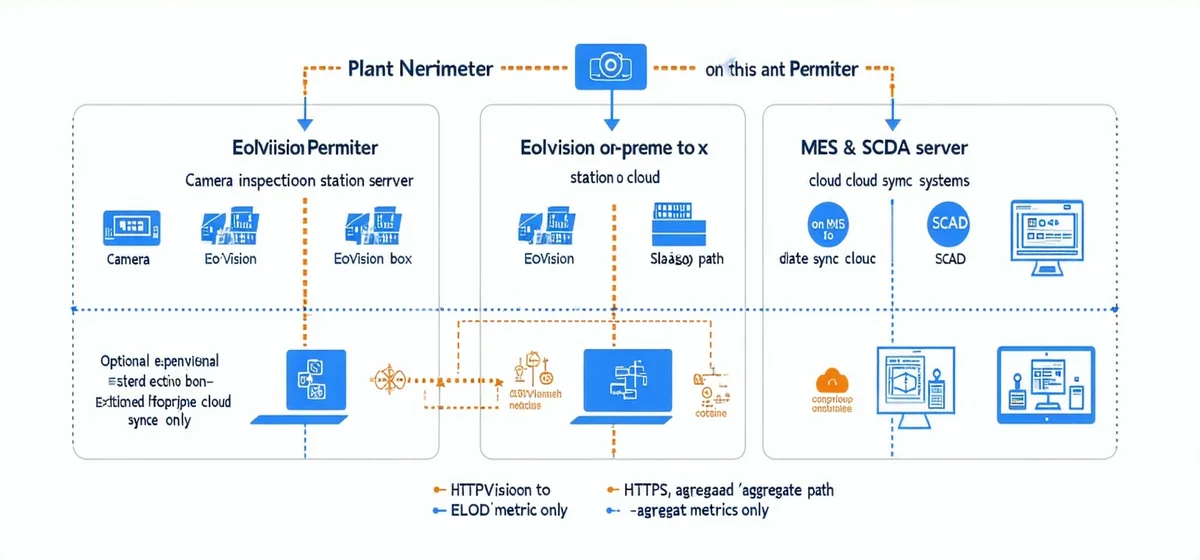
What data goes where
Local inspection storage
Inspection images and verdict records are stored on your plant server. Retention period is configurable from 7 to 365 days. Images are stored in your plant network's storage — not in Eolvision cloud infrastructure. Your IT team controls access and backup.
Optional cloud sync
If enabled, Eolvision syncs aggregate metrics (reject counts, defect type distributions, model performance statistics) to the Eolvision cloud dashboard over TLS 1.3. Raw inspection images are never included in the cloud sync path. Cloud sync can be disabled entirely — the system runs fully air-gapped.
User access control
Eolvision authenticates users against your plant network directory (Active Directory or LDAP). No external identity provider required. Role-based access: inspector role (view only), QC manager role (view and export), admin role (configure and update). Audit log of all access events.
Network isolation and port requirements
Designed with manufacturing quality controls in mind
Eolvision's data handling and record-keeping capabilities are designed to support the documentation requirements of common manufacturing quality standards. These are design decisions, not compliance certifications.
Automotive quality management — designed to support documentation requirements
Eolvision inspection records include the fields required by IATF 16949 Section 8.6 (control of nonconforming outputs) and Section 8.7 (customer escape reporting): part identification, inspection timestamp, defect classification, verdict, operator (automated), and defect image. Export formats compatible with common QMS document control systems.
Quality management systems — designed to support document control requirements
Inspection procedure configurations (camera settings, model version, acceptance thresholds) are versioned and change-controlled within Eolvision. Configuration changes require authorized role. Audit trail of all configuration changes with timestamp and user identity — designed with ISO 9001 Section 7.5 document control controls in mind.
Electronic records for medical device lines — designed with relevant controls in mind
For customers operating medical device production lines: Eolvision's audit trail, user authentication, and record integrity features are designed with 21 CFR Part 11 electronic records controls in mind. Not a 21 CFR Part 11 validated system — validation is the customer's responsibility. Eolvision provides documentation support for your validation process.
Request a security architecture review
Our engineering team will walk through your plant network topology, OT/IT boundary, and specific data handling requirements.